
‘The Spring Symphony of Goumang and Persephone’ Review: Making Sense of the ‘None-Sense’
Text / Sid Chen
English translation / RYE LIN ART & TRANSLATION
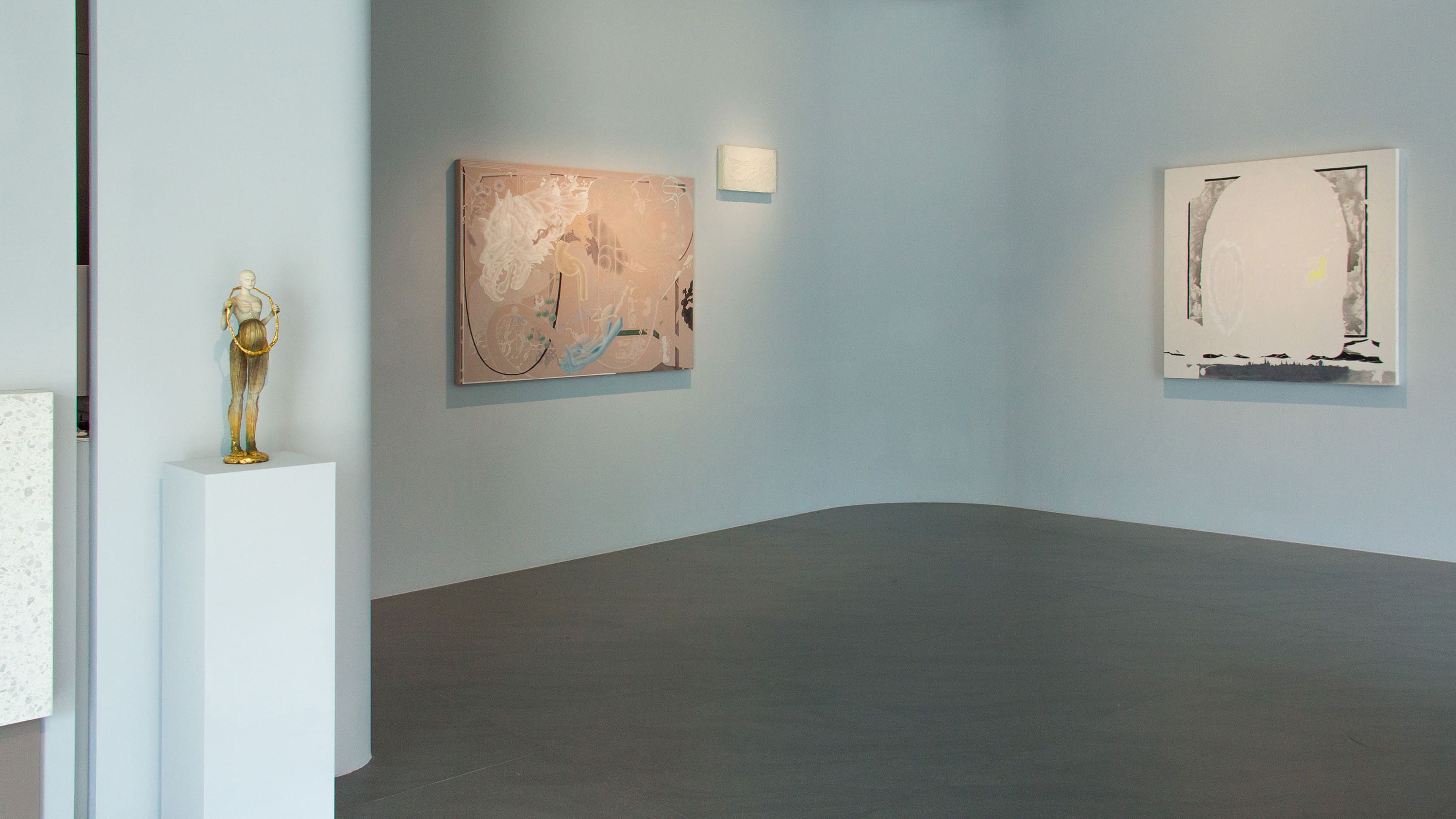
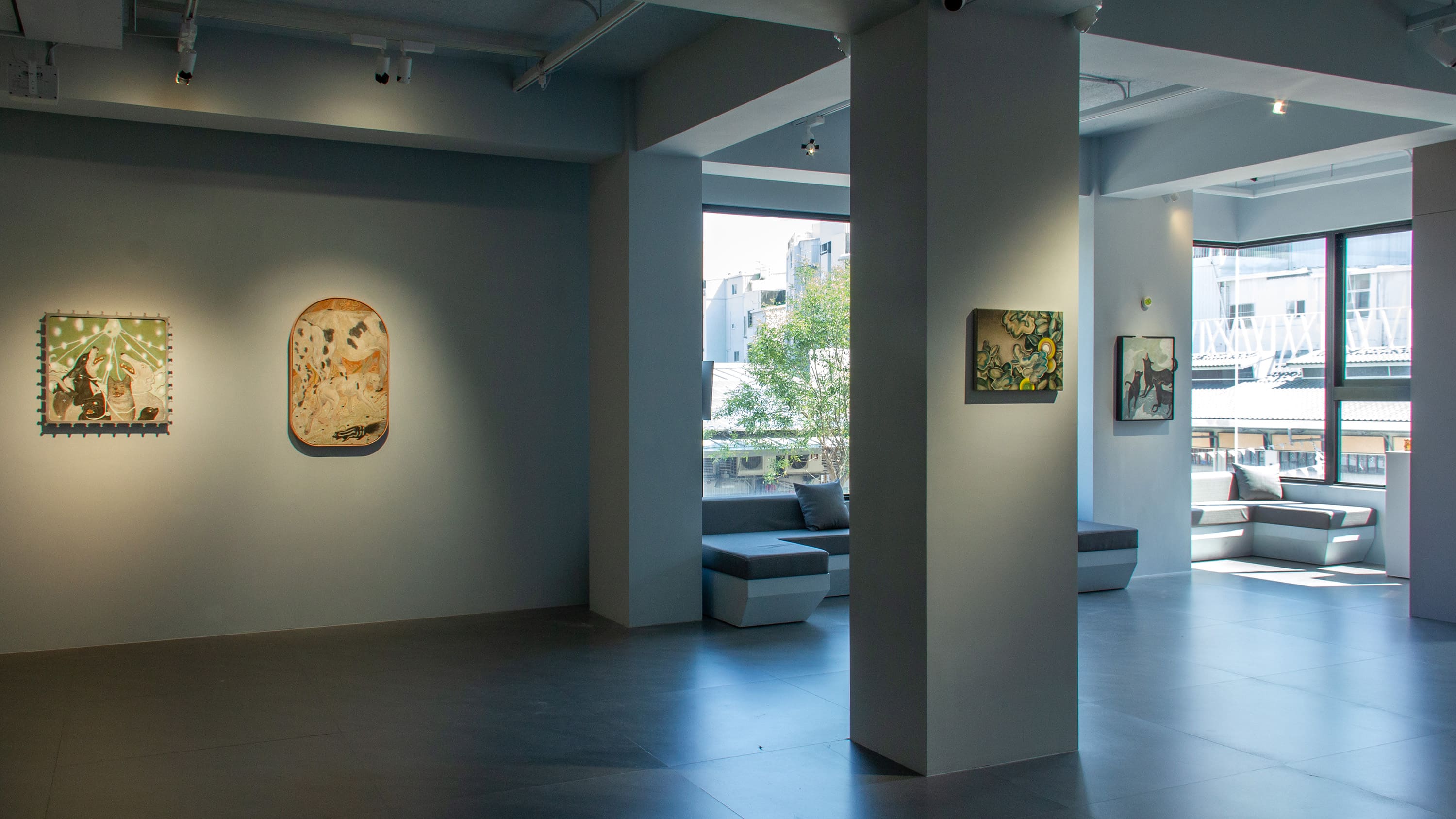
The Spring Symphony of Goumang and Persephone (hereafter Spring Symphony) at Moolah Multi-Art Space presents works created in the early 2020s by three artists: WANG Ting-Yu, CHENG Nung-Hsuan, and HONG Yong-Xin. Spanning three floors, the exhibition makes immediately apparent these three mid-career artists’ shared investment in the classical and the archaic, and their distinct approaches to the very essence of painting, to figuration, and to form. These three artists, along with the location of the Moolah – situated in Tainan, Taiwan's most historically rich city, directly opposite the newly renovated Tainan West Market – set my thoughts in motion long before I walked into the gallery. Is this not, after all, a city and an exhibition engaged in the same essential question: how do contemporary life and aesthetics coexist with history? How does one sustain a dialogue between the two, and kindle – amid surroundings dense with historical trace – something resembling the vital energy of a spring symphony? With these questions in mind, I entered the gallery, ready to encounter the works and uncover the metaphor of spring in this exhibition.
Making Sense of the ‘None-Sense’
Although Gou-mang and Persephone both embody spring – in Chinese and Greek mythologies respectively – their visions of the season carry markedly different connotation. Gou-mang serves as attendant to the god Emperor Taihao, presiding over the arrival of spring and holding dominion over invention and creation. Persephone, by contrast, assumes shifting identities across the many versions of her myth; most iconically, she is the bride taken by force, and all living things depend on her presence to exist – when she departs, the world withers; when she returns to the earth and to her mother, everything is reborn. Through these mythologies, and under the aegis of the exhibition’s title, I turn to the practices of the three artists, tracing how each unfolds their vision across richly layered worlds of imagery in full bloom.
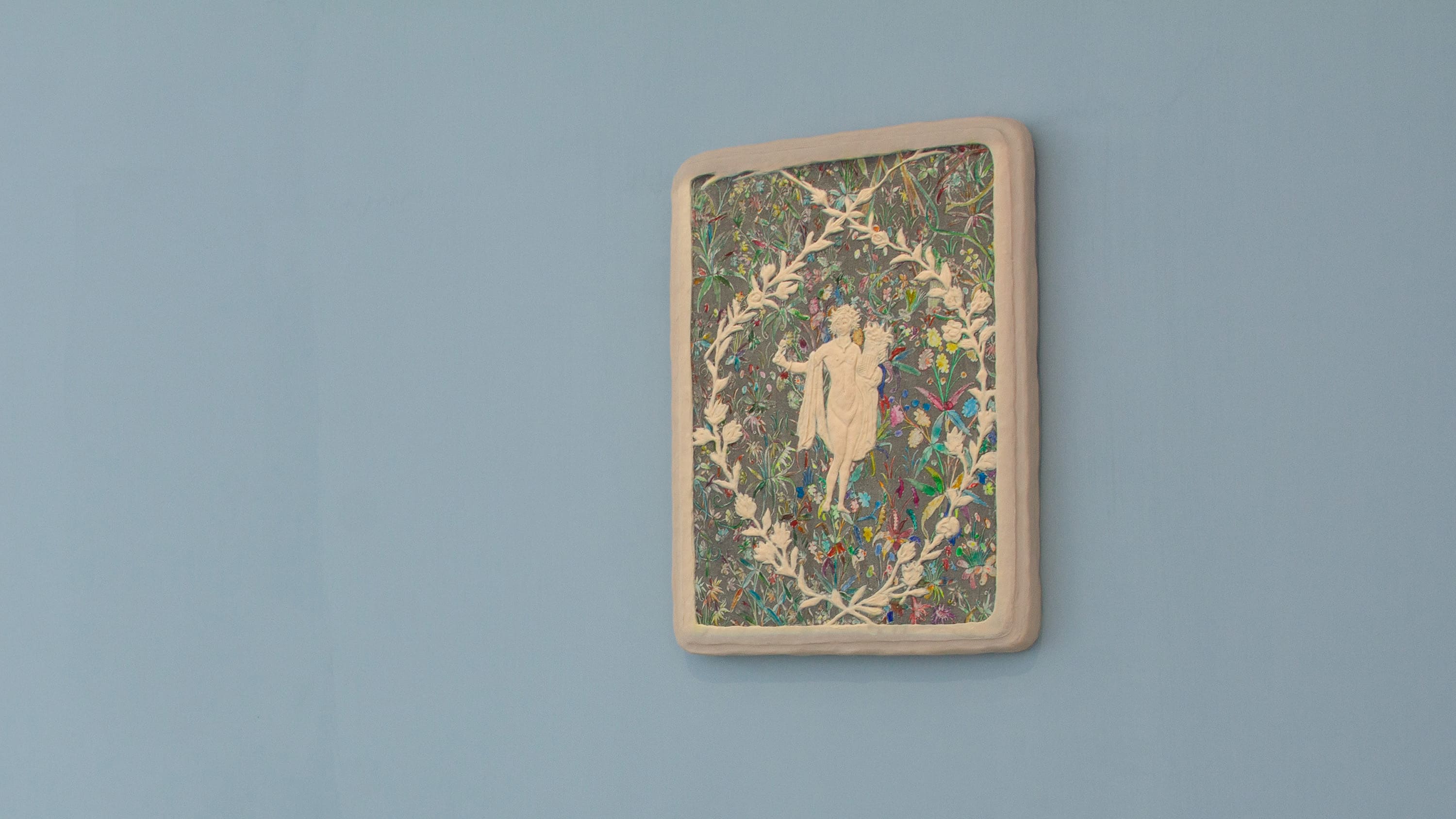
In Spring Symphony, three artists each enter into dialogue with the archaising, classical, and decorative aspect of art history. A viewer familiar with the canon of Eastern and Western art traditions can readily imagine how these contemporary artists engage with such aspects on their own aesthetic terms. Taiwan may not be a nation with a long, deeply rooted art-historical tradition of its own – art, after all, arrived as a foreign concept – yet within the world of art, Taiwan’s contemporary practitioners are free: free to choose their interlocutors, to copy, even to subvert; free to locate themselves within any historical contexts. This practice of making sense of the ‘none-sense’ – enacted through their acts of selection and composition – was long denied any positive legitimacy. Today, however, it has become a founding gesture for many artists, and indeed for biennials of contemporary art, as a point of departure for aesthetic thought inquiry and the expansion of imaginative possibility. The subsequent challenge, aesthetically speaking, is whether such creative freedom can actually generate a productive dialogue between the artist and the subjects they have chosen to address. It is through this process of making sense of the ‘none-sense’ – by working within and against received aesthetic discourse – that art carves open a space capacious enough to hold multiplicity: one in which contemporary practitioners may challenge existing assumptions and press the imagination further still.
WANG Ting-Yu: The Constellation as Totality
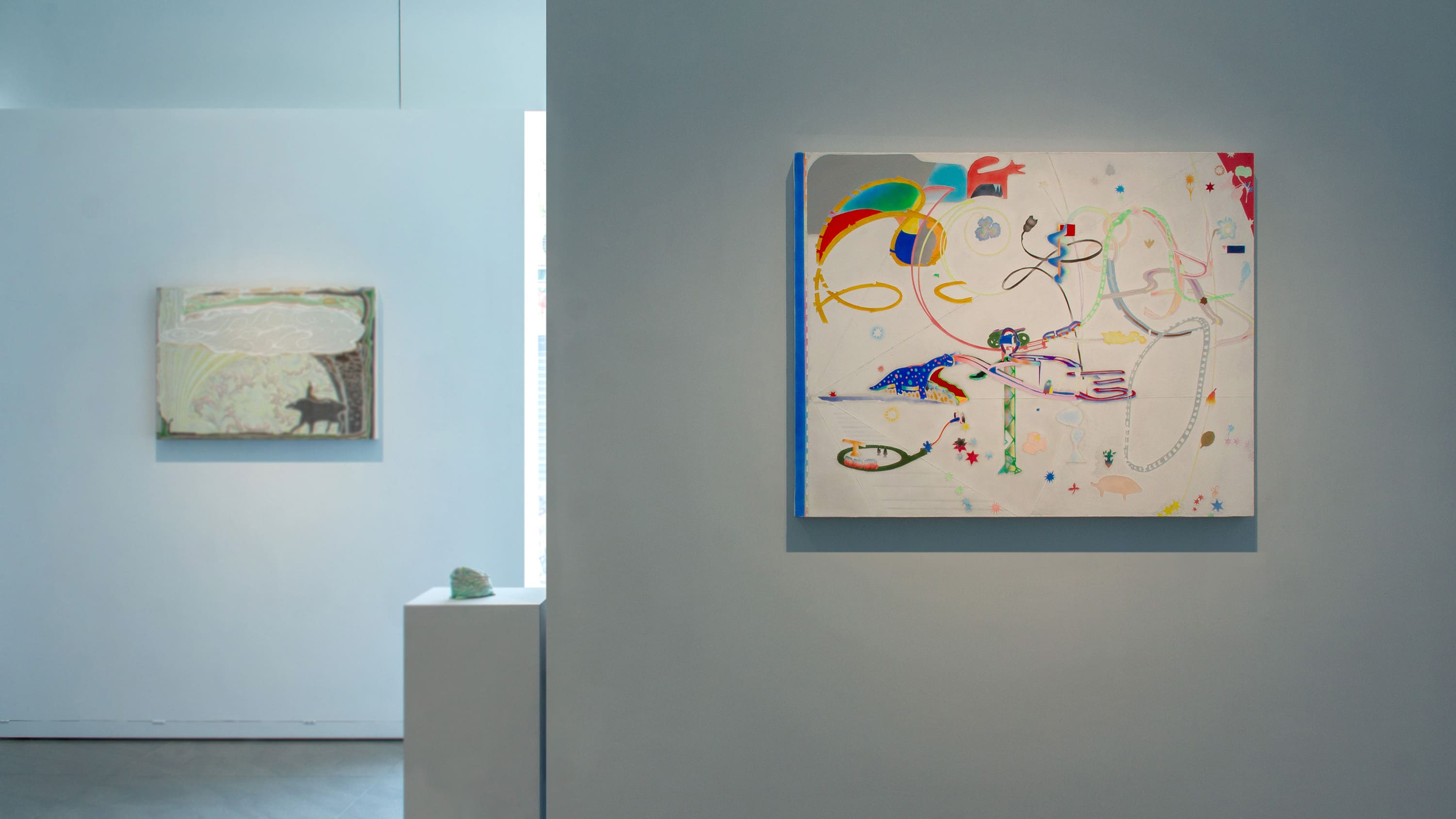
Making sense of the ‘none-sense’ is a mode of creative thinking that rises with postmodernism, using the subjectivity of art-making to pose questions across differing aesthetic ethics, rather than allowing itself to become a mere illustration of any single aesthetic or philosophy. This quality, I think, is also why Wang’s work perpetually interrupts my sensory experience of looking at a painting. On what basis exactly does Wang make these easel paintings? Standing before his work, meaning drifts and will not settle. I find myself lost in images that resist easy recognition – held in suspension by the incomplete, intensely hand-worked excavations of contour and outline, by the iridescent gradients. Take Dragon Wheel of Pure Flame (2023): in the upper left, a dragon’s head rendered in white outline and luminous gradation; a relief-like technique traces the coiled body through space; in the lower centre, what I take to be a dragon’s claw emerges in sky-blue gradation; the surrounding areas resolve into layered planes of colour. Scattered across the canvas are tarot images – for those unfamiliar with the iconography, they likely register as nothing more than indistinct, exotic marks.
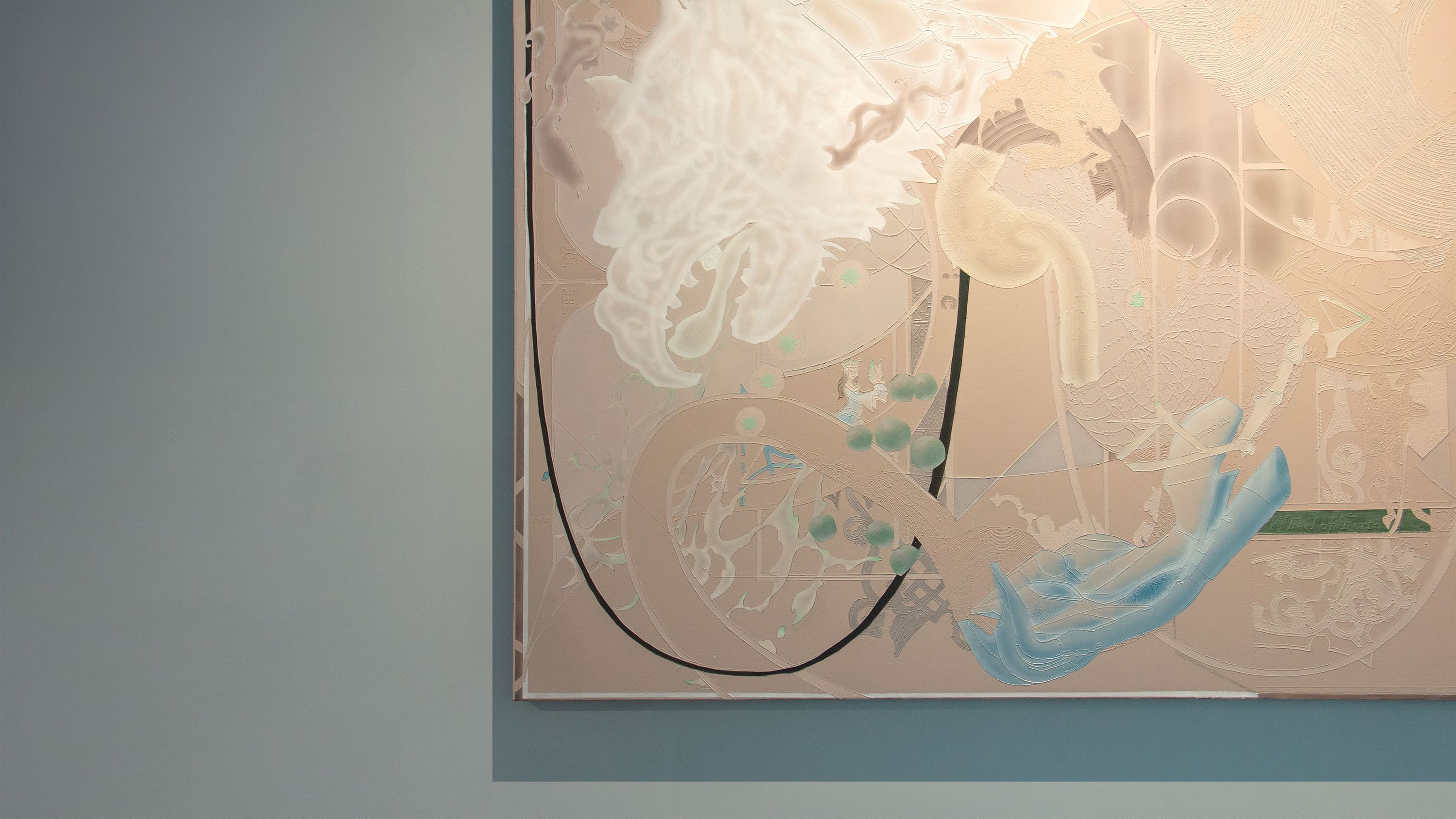
Wang consciously interrupts the pictorial totality that painting is expected to produce in its traditional sense. Working across different senses and dimensions, he allows what appear to be fragmented parts to be assembled into a surface whole – the constellation-like totality. The viewer standing before the canvas is like someone on earth tracing constellations from the pattern of stars. We happen to occupy a position in this visual field from which certain relations appear to align; from another vantage, those same relations might look entirely different, or prove unrelated altogether. I believe this is Wang’s attempt, within the domain of contemporary painting, to construct a perceptual network that escapes the grasp of meaning and language. Between Dadaist anti-meaning and the modernist treatment of painting as visual language, he employs something akin to negative dialectics, treating the pictorial elements as documents that do not necessarily form a coherent text between them. According to Betty Edwards, painting can capture immediate connections in a single image,¹ and it is precisely in this spirit that Wang responds to the complexity of life and thought, allowing the vitality of imagination and perception to arise.
CHENG Nung-Hsuan: A Theatre of Affiliation
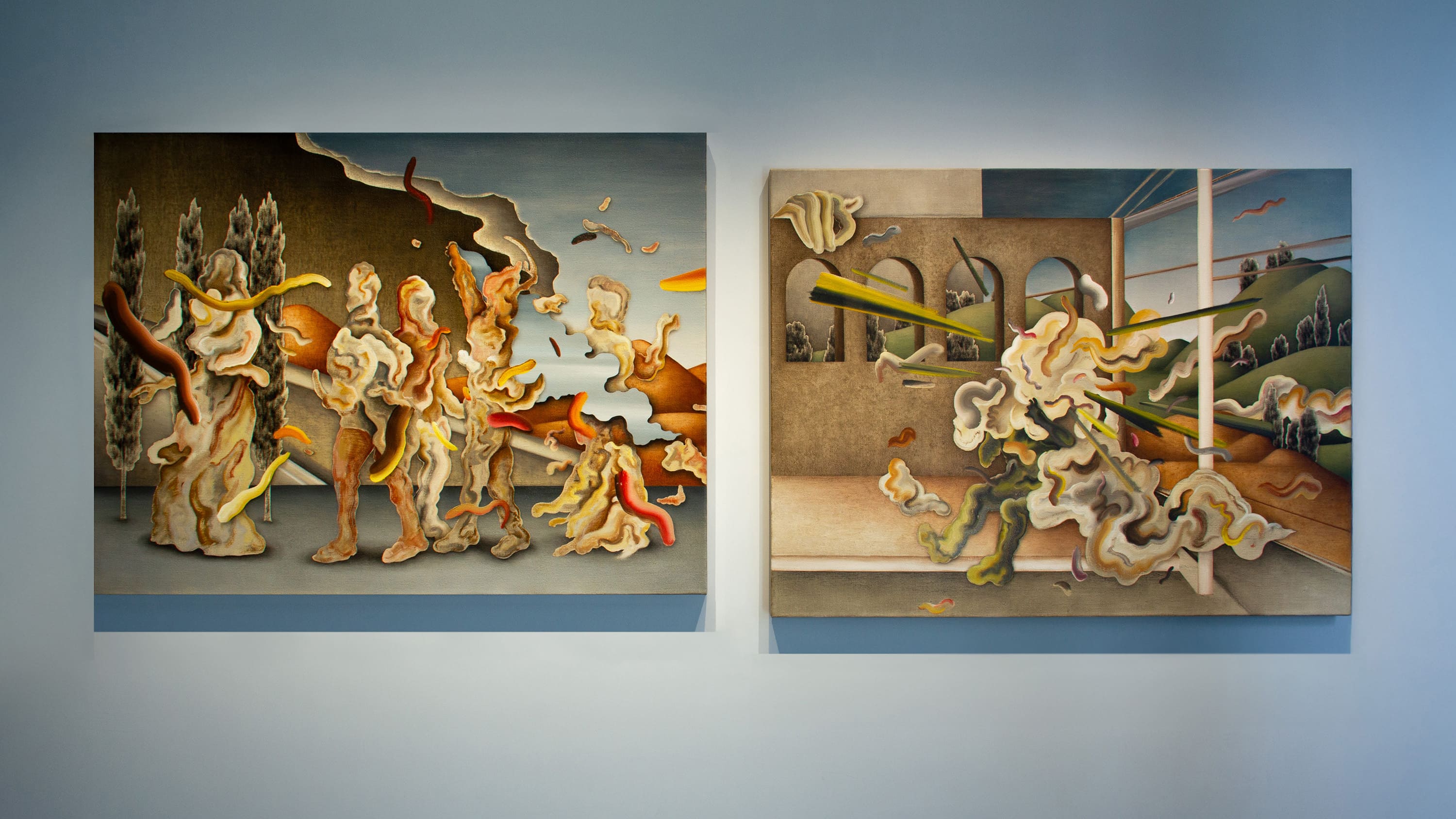
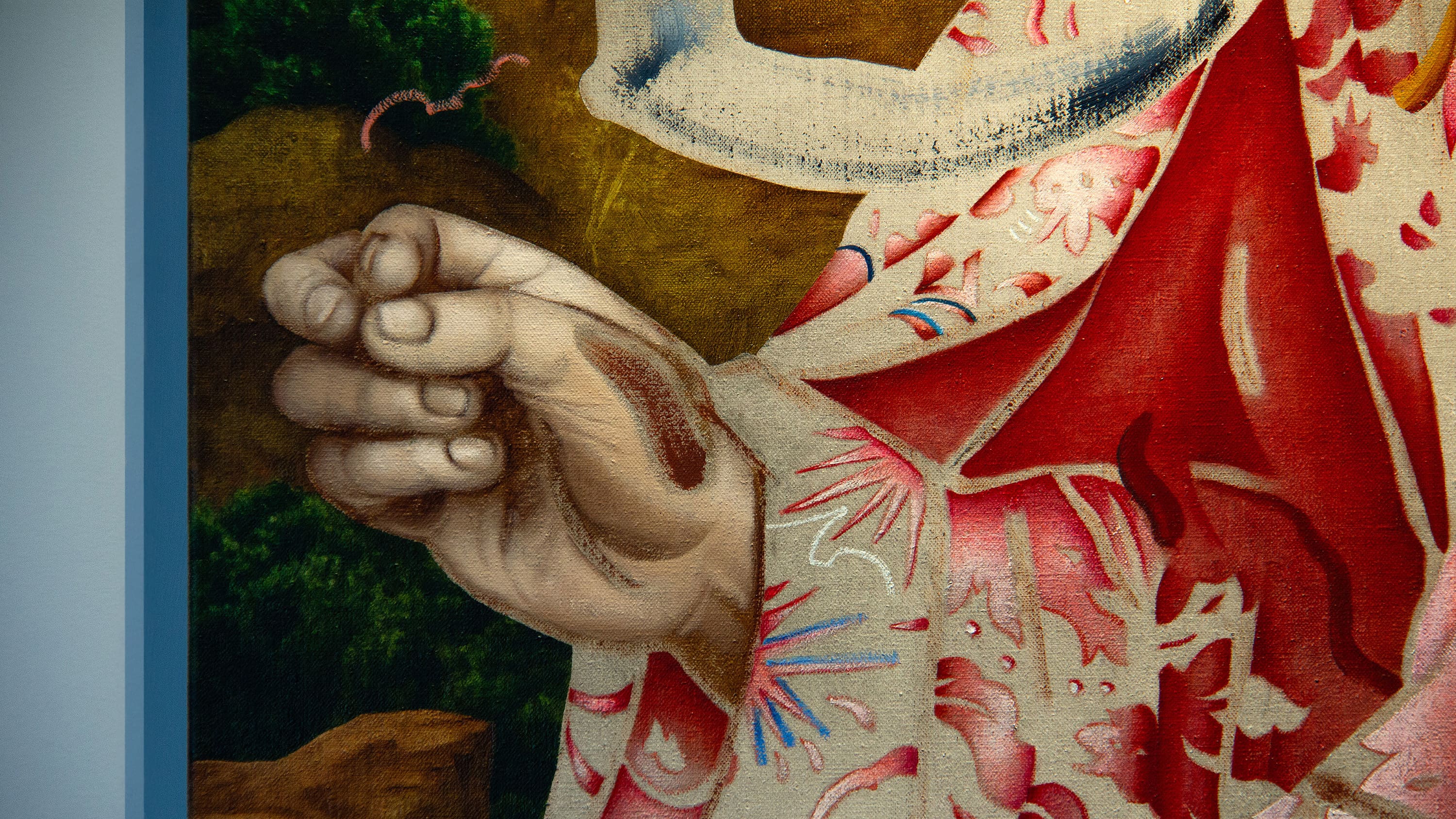
Cheng's Untitled Saint IX (2025) and Messenger no. 28 (2023), viewed within the framework this exhibition provides, lead me to connect his work to certain classical sources in Western painting history that Wang Ting-Yu also draws upon. The chromatic layering in both works is deliberately preserved, so that to look through those layers is to experience something resembling a collaged theatre assembled from fragments across different planes. Both Cheng and Wang abandon what the image might conventionally be expected to look like – the former through erasure, the latter through excavation. This is how contemporary painting refuses to be judged by the overly legible forms: Cheng wishes us to see through his thinking about the nature of painting itself – its strata, its colour, and the accumulated aesthetic experience sedimented within the Western canon.
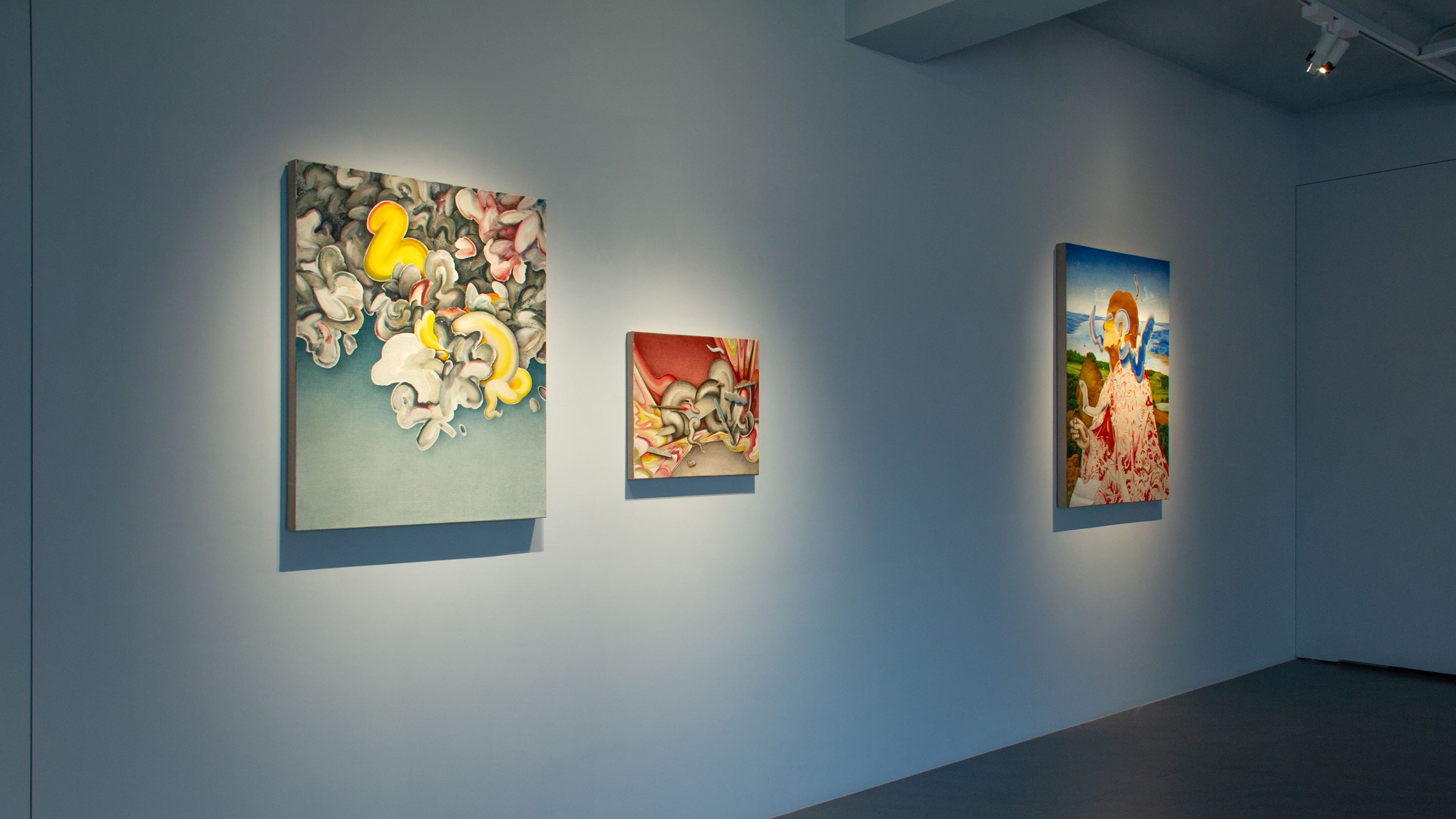
Untitled Saint IX adopts the format of Northern Renaissance portraiture: the background and the robes of the faceless saint are handled in monotone, evoking the separated layers of a woodblock print. In the lower left, the ceremonial staff towards which the most legible hand reaches is absent, rendering the subject a saint stripped of authority and identity. Returning to the title, the juxtaposition of untitled and saint, held in affiliation within a single image, is charged with tension. Untitled is a word long associated with minimalism and abstraction, with the removal of all interpretive cues; saint, by contrast, is a signifier dense with specific symbolic weight. The painting maps precisely onto the artist’s reflection on a long-debated question in Taiwan’s post-war art scene: the relationship between abstraction and figuration, and the contradiction between the weight of painting history and one’s own position as a contemporary artist. From contradiction, from rupture, and from the new growth that springs from grafting, contemporary painting practices are born.
HONG Yong-Xin: Stepping Out from the Past
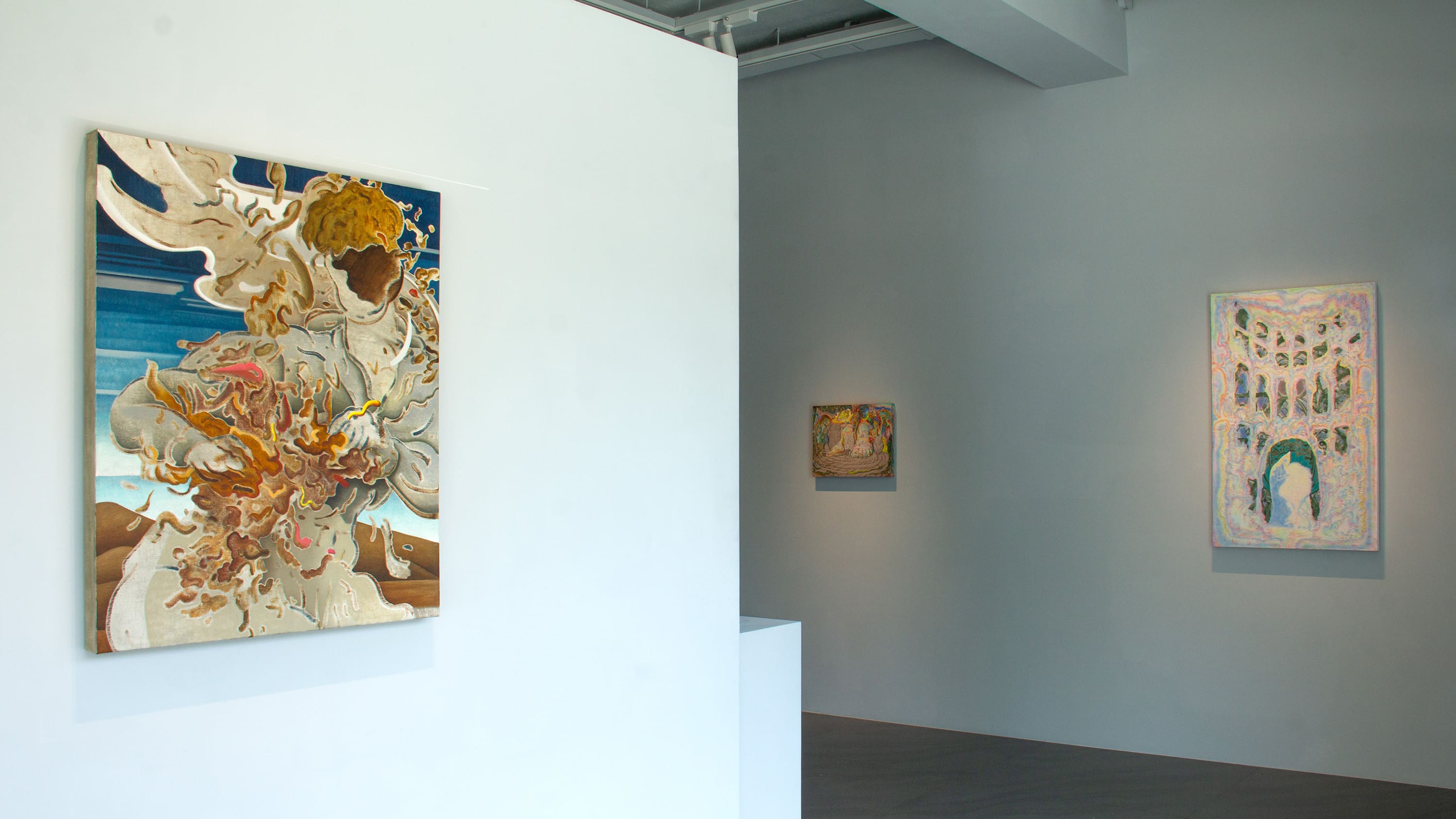
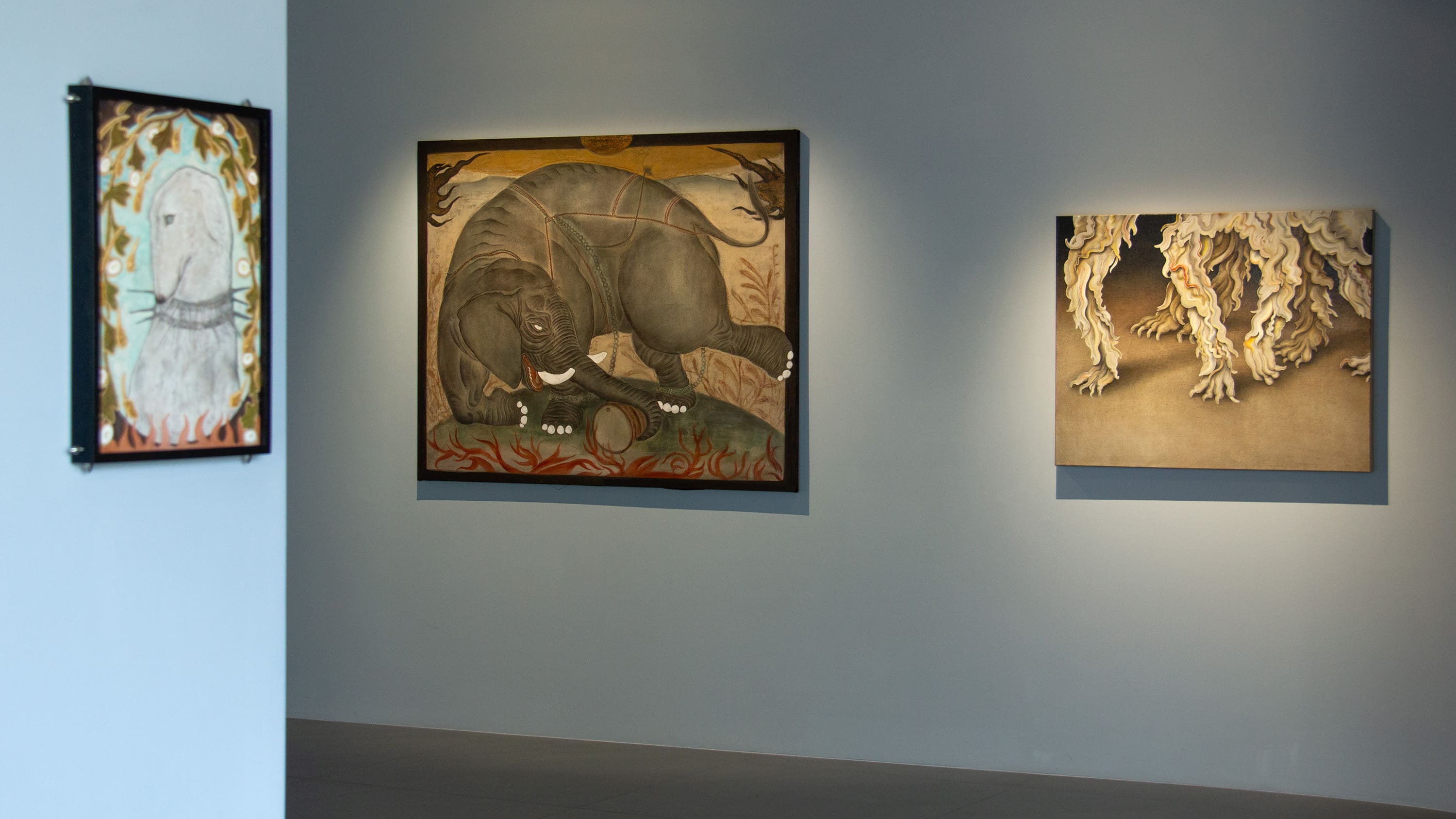
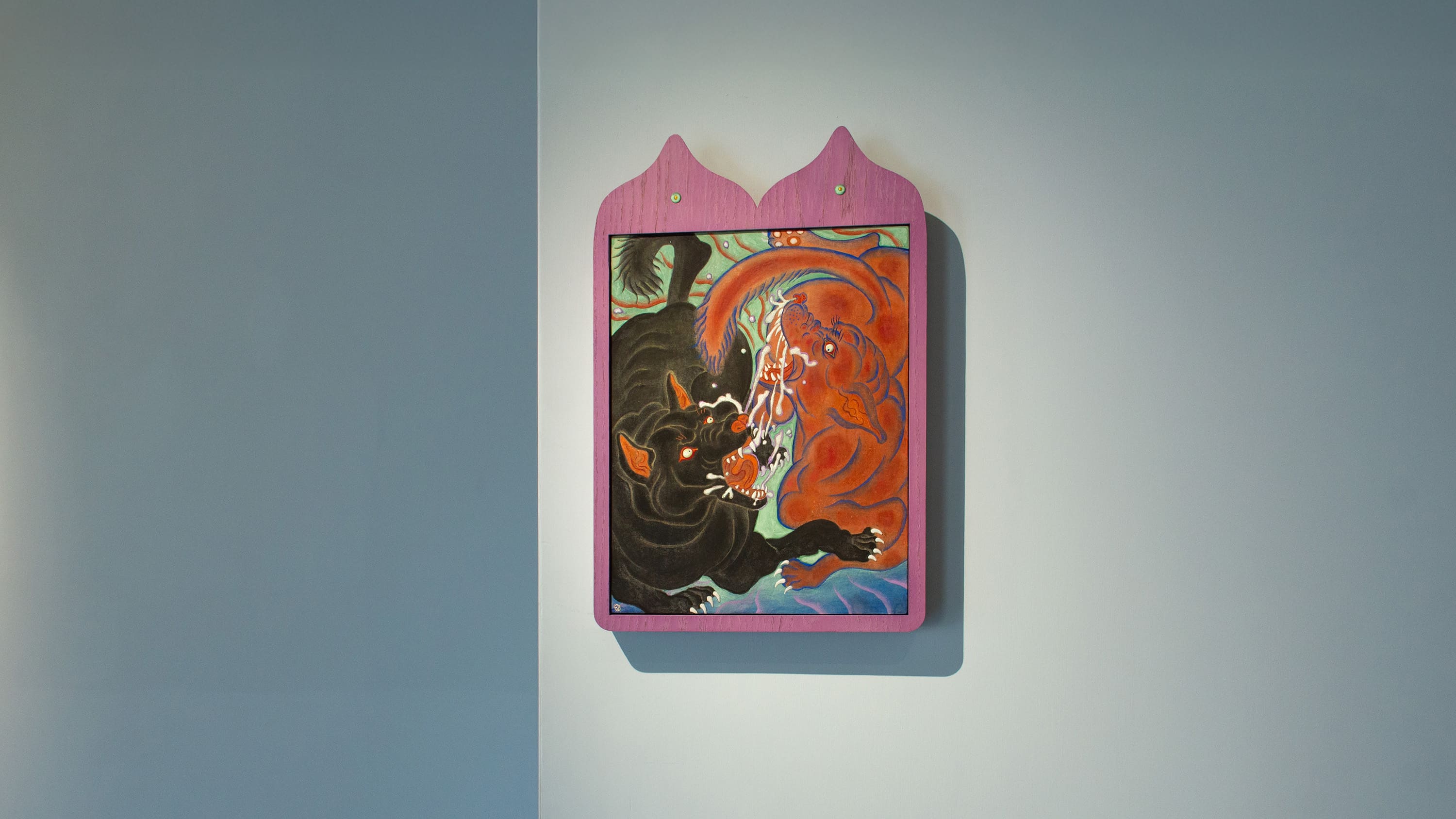
The longing for pastness and the visible trace of hand are evidence that many contemporary painters do not regard modernism, nor the traditional and classical, as things to be discarded. Hong deliberately cultivates a sense of chromatic and tonal restraint through aged, archaising materiality, so that even where tension exists in the image, it remains a tension held entirely in the past tense. In rendering form, she draws fluidly on ancient Roman vessels, Dunhuang murals, religious painting, and Art Nouveau – while her animals occasionally call to mind the wit of contemporary memes. It is precisely her assured command of manufactured pastness, gradation, form-making, and the hand-painted border that lends her surfaces so strong a quality of workmanship and artisanal making. Her 1945 in Burma – a work in homage to Lin Wang, the Asian elephant who served during the Second World War – moves between subject, proposition, and chosen scene through a kind of personal, leaping association, yet as a whole conveys the artist’s deep respect for a life that endured and survived great suffering.
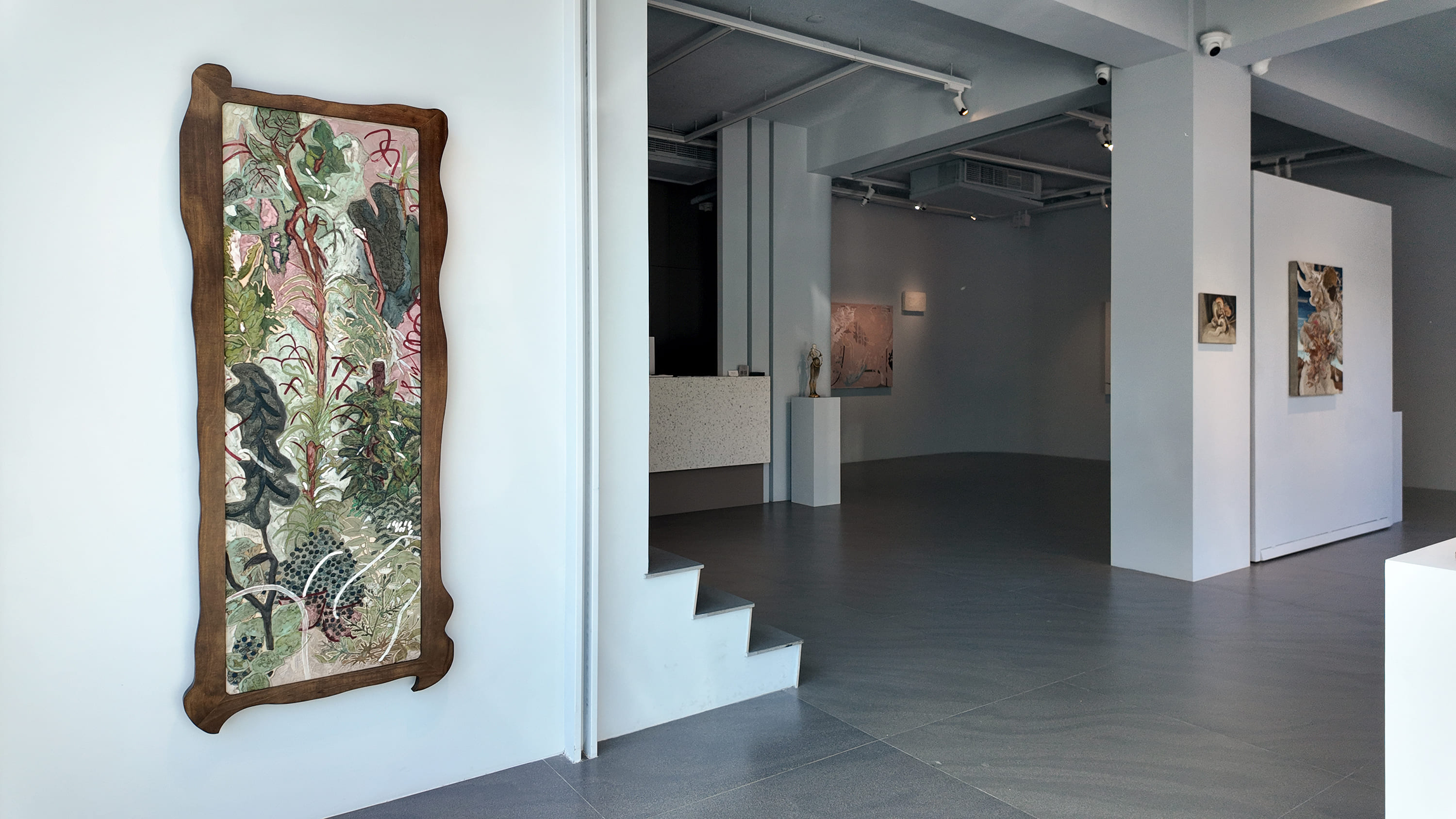
Offbeat Growth is, in Hong’s practice, a somewhat exceptional work in terms of form, composition, and brushwork. Here, pigment seems to overflow the contours of its subjects – a distinctly painterly impulse – expressed through the differentiated depiction of various plants across differing qualities of line. In these recent works, one senses Hong moving steadily toward another stage, no longer content with archaism and aging alone; the new energy in her practice begins precisely at these moments of breaking through her own established frame.
Faced with the far reach of art-historical lineage and the long development of various art techniques, the question of how artists generate vitality in contemporary practice – without collapsing into decontextualised, ahistorical self-expression – is among the reasons contemporary artists today actively turn towards the past when reflecting on their own practice. The three artists of Spring Symphony, in their attention to the pictorial surface and their handling of layered time and space, regenerate a sense of relatedness between different subjects held together on a single plane. As they make sense of the ‘none-sense’ through the gaps between varying meanings, differing languages, and diversified colours, an aesthetic and imaginative vitality takes root. Whether a canvas or a city, the principle holds.
¹ Paraphrased from Drawing on the Right Side of the Brain by Dr Betty Edwards, who holds a Doctorate in Art, Education, and Psychology. Edwards's account of the structural difference between language and drawing offers a useful point of reference for the notion of painting as something operating outside language.
