
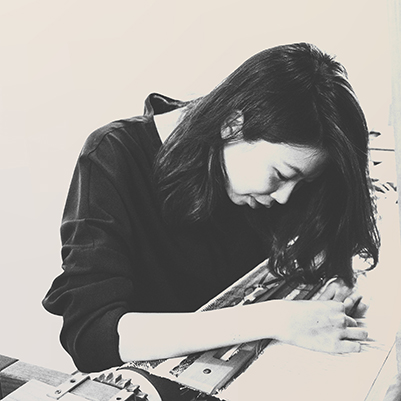
畢業於臺南藝術大學應用藝術研究所。
她認為人從出身到死亡,都有織物溫柔地包覆著身體,不同質地﹑肌理﹑色彩﹑圖案的織物都經由每個人的選擇,紀錄著大家的生活不同的時刻,並反射其中不斷變化的情感意義。從服裝設計學系畢業後先在服裝產業工作幾年,她強烈地感受到布料和服裝的生命週期實在太快,轉而投入纖維藝術的領域。她一直保有對紡織品探究的高度熱忱,紡織技術和工具種類繁多,她選擇專攻數位提花梭織,以電腦位元編碼抽象邏輯思考,設計繪畫的圖像經過紡織結構的技術處理後織造成織毯﹑再以繪畫或布料表面處理加工細節,創作的織畫作品有別於印刷與繪畫,看似二維圖像近看有三維線條堆疊的層次,繁複的過程都是為了充分運用不同紡織材料的質感,並藉由作品紀錄屬於台灣當代藝術掛毯的特徵。
其2014-2015年間她的織畫作品融合東方山水與西方風景體系的思考,以織代筆像是找尋自身價值的修行儀式,也希望觀看這原鄉想像的人們也能夠結合個人的經驗感悟人生。畢業不久便得到台灣工藝競賽美術工藝組首獎的肯定,作品同時兼具傳統纖維工藝的底蘊和當代藝術概念思維,2016年得到晶華酒店的藝術品訂製邀約,耗時一年製作中國重慶霧景的藝術屏風。2017-2018年間她密集走訪蘇州與京都園林,探索人造建築中對風景的想像,發展出以中山水為用,枯山水為體的仙山系列。參考僧侶為感悟禪宗在庭園白沙耙出重複的紋理,將原本中式山水的留白刻劃了重複與秩序化的痕跡-這些似曾相識的服飾紋樣是人類紀錄生活經驗與傳承歷史與文明的重要載體。2019年後,她覺得當代風景中的環境問題是不能忽視的,自己應該刻不容緩地透過創作的力量表達對環境的關切,所以除了原本的風景織畫脈絡以外,她刻意將眺望大山大海的視角拉近至微觀你我周遭的池塘,鼓勵觀者跳脫常規思考,從不同角度覺察生活環境的改變和遺漏的細節。作品往往會借鑒一些西方或東方古典的元素,和當代產生微妙的衝突與平衡,呈現工藝又寫實、機械又人文的矛盾之美。
She graduated from the Graduate Institute of Applied Arts at Tainan National University of the Arts.

She believes that from birth to death, the body is gently enveloped by textiles. Different textures, textures, colors, and patterns of textiles are chosen by each individual, recording the different moments in everyone’s life and reflecting the constantly changing emotional significance within. After graduating from the Department of Fashion Design, she worked in the fashion industry for several years. However, she strongly felt that the life cycle of fabrics and clothing was too fast. Consequently, she transitioned to the field of fiber art. She has always maintained a high enthusiasm for exploring textiles, given the diverse range of textile techniques and tools. She chose to specialize in digital jacquard weaving, employing computer bit encoding for abstract logical thinking. The images designed are processed through the technical treatment of textile structures, woven into tapestries, and further processed with painting or fabric surface treatment to add details. Her woven painting works distinguish themselves from printing and painting. They appear as two-dimensional images, but upon closer inspection, reveal a three-dimensional layering of lines. The intricate process is aimed at fully utilizing the textures of different textile materials, documenting the characteristics of contemporary Taiwanese tapestries in her works.

In her works from 2014 to 2015, she blended the contemplation of Eastern landscapes with Western scenery. Weaving, in her perspective, is a ritual of self-value exploration. She hopes that those who view her imagined homeland can also integrate their personal experiences to comprehend life. Shortly after graduating, she received recognition for the first prize in the Taiwanese Crafts Competition Art Craft Group, showcasing the depth of traditional fiber craftsmanship combined with contemporary artistic conceptual thinking. In 2016, she received an invitation to create customized art for the Regent Taipei Hotel and spent a year crafting an art screen depicting the misty scenery of Chongqing, China.

During 2017-2018, she extensively visited gardens in Suzhou and Kyoto, exploring the imagination of landscapes within man-made structures. This exploration led to the development of the Xian Shan series, utilizing Zhongshan Shui (Chinese landscape) and Karesansui (dry landscape) elements. Referencing the repetitive patterns raked by monks to comprehend Zen Buddhism in the gardens, she depicted the repetition and orderliness of these familiar dress patterns, serving as important carriers of recording life experiences and passing down history and civilization.

After 2019, she felt that environmental issues in contemporary landscapes could not be ignored. She believed it was imperative to express her concern for the environment through the power of creation. In addition to the original context of landscape weaving, she deliberately brought the perspective of gazing at mountains and seas closer to the micro-view of ponds around us. She encourages viewers to break free from conventional thinking, observing changes in the living environment and the overlooked details from different perspectives. Her works often borrow some classical elements from the East or West, generating subtle conflicts and balances with the contemporary, presenting the contradictory beauty of craftsmanship and realism, machinery, and humanity.
